Home

Home2026-05-06T22:07:17+03:00

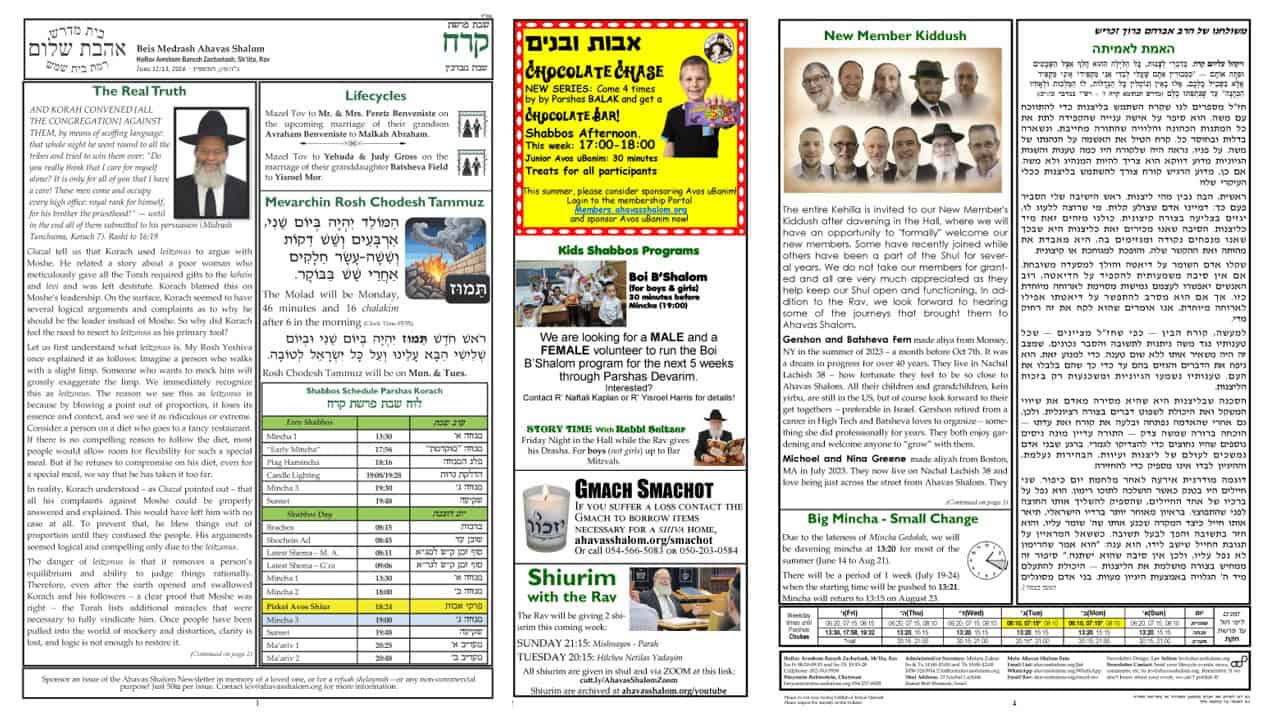
האמת לאמיתה

By |June 8th, 2026|Categories: הבלג של הרב|Tags: , |

ויקהל עליהם קרח. בְּדִבְרֵי לֵצָנוּת, כָּל הַלַּיְלָה הַהוּא הָלַךְ אֵצֶל הַשְּׁבָטִים וּפִתָּה אוֹתָם — "כִּסְבוּרִין אַתֶּם שֶׁעָלַי לְבַדִּי אֲנִי מַקְפִּיד? אֵינִי מַקְפִּיד אֶלָּא בִּשְׁבִיל כֻּלְּכֶם, אֵלּוּ בָאִין וְנוֹטְלִין כָּל הַגְּדֻלּוֹת, לוֹ הַמַּלְכוּת וּלְאָחִיו הַכְּהֻנָּה" עַד שֶׁנִּתְפַּתּוּ כֻלָּם (מדרש תנחומא קרח ז' – רש"י במדבר טז:יט): [...]
New vs. Old: What My Father's Prayer Book Taught me

Beis Medrash Ahavas Shalom 15 hours ago

Why I Never Sleep At My Desk A Lesson for Life

Beis Medrash Ahavas Shalom November 15, 2026 22:13

Lost Art: The Fascinating Aish Tanur Oven

Beis Medrash Ahavas Shalom November 13, 2026 12:59

Digital Libraries DON'T Make You a Rabbi!

Beis Medrash Ahavas Shalom November 12, 2026 14:09

One Habit Reduces Divorce by 60x!

Beis Medrash Ahavas Shalom November 12, 2026 12:21

Rabbi Avrohom Baruch Zachariash teaches the halachos of Breaking Bread with the Mishnah Berurah (O.C. 167)

AI Summary:
Blessings After Eating Discussion
The discussion focused on a Jewish legal question about making blessings (brachas) after eating, particularly when there might still be room for more food. The participants explored different perspectives on when and why blessings should be made, including the concept of "shamoa koaina" where hearing someone else make a blessing can fulfill the requirement. The conversation touched on a comparison to the well-known question about answering during Shmona Esrei and Mir Kedusha, though the specific answer was not fully resolved in the discussion.
Halachic Bracha Interpretation Discussion
The discussion focused on halachic interpretations regarding brachas and responses to them. The Night Viewer argued that certain bracha responses were not permitted, while others maintained that proper responses were acceptable as long as they were made at the appropriate time and did not contradict the original bracha. The conversation also touched on the requirements for properly saying brachas, including the need to include specific words and translations, particularly regarding "Elokeinu" and proper Hebrew sources.
Halachic Definition of Eating Together
The discussion centered on a halachic question about what constitutes "eating together" in different scenarios, particularly when people are physically in the same location but not actively participating together. The speaker explored whether simply being in the same place counts as eating together, concluding that while being physically present is necessary, there needs to be some form of shared intention or action, such as explicitly stating they are eating together. The conversation also touched on how family meal patterns have changed over the past 50 years and referenced a Catholic Church study showing that people who eat supper together as a family are 60 times less likely to get divorced.
Travel Eating Halachic Guidelines
The speaker discussed halachic rules about eating while traveling, using the example of eating a bag of potato chips while walking to a car. They shared a personal story about giving a shiur on travel-related halachas, including the question of whether sitting on a bus while eating would invalidate the bracha. The speaker mentioned that while some people believed sitting down would ruin the bracha, they maintained their original position that it would not be problematic, and later confirmed this with Rabbi Weber from Neve Jacob.
Jewish Religious Practice Guidelines
The discussion focused on Jewish religious practices and halachic interpretations, particularly around the requirements for making blessings and kiddush. The speaker explained that women sometimes have incorrect beliefs about religious requirements, noting that while kiddush traditionally must be made by a man, it is not strictly required according to some interpretations. The conversation also covered the proper procedures for giving berachot to guests, with discussion of whether a kohen should receive the berachah at every meal and how to handle situations where multiple people want to make the blessing. The speaker emphasized that having knowledge of halachic texts does not automatically qualify someone as a rabbi, citing Rabbi Herschel Schachter's important teshuvah on this topic. Halachas of Breaking Bread 167 - Zachariash (4)

Halachas of Breaking Bread 167 - Zachariash (4)

Beis Medrash Ahavas Shalom November 10, 2026 21:58

Rabbi Avrohom Baruch Zachariash teaches the halachos of Breaking Bread with the Mishnah Berurah (O.C. 167)

AI Summary:
Halachic Blessing Rules Discussion
The Rav discussed halachic rules about making blessings and eating, specifically addressing when a new blessing is required after someone has already eaten. They explained that if a person makes hamotzi before eating, a new blessing is needed if more food is taken later, but if the person has already eaten, a new blessing is not required even if more food is taken. The Rav also mentioned finding relevant information in a text about using pantomime instead of talking in certain situations.

Brachas and Food Obligations Discussion
The Rav discussed questions about brachas (blessings) and food obligations, specifically addressing scenarios where someone makes a bracha for a meal but others don't eat immediately. The discussion explored when a new bracha would be required and the circumstances under which someone could eat food that was blessed for others. The conversation remained unclear and unresolved, with The Rav suggesting that common sense might not fully address these halachic questions.

Religious Wine Consumption Discussion
The Rav discussed religious topics related to wine consumption and Yom Kippur, explaining that according to the Gemara, babies can drink water on Yom Kippur. The Rav shared that different generations tend to ask similar questions about religious practices, even without direct correspondence between individuals. The discussion appeared to be exploring distinctions between different religious practices and interpretations.

Kiddush Practice and Requirements
The Rav discussed the practice of saying Kiddush and clarified that its primary purpose is to recite the blessing over wine, not to fulfill other customs like eating gefilte fish. He addressed a question about what to do if one forgets to make Kiddush, explaining that while some people recite a blessing anyway, there is no halachic requirement to do so if one didn't intend to. The Rav emphasized that the main focus of Kiddush is the blessing over Shabbat, distinguishing it from other customs that may be performed alongside it.

Blessings Before Eating Halachic Principles
The Rav discussed halachic principles regarding making blessings before eating, using examples to illustrate key concepts. He explained that one must make a blessing before eating, even if offered food after someone else, and shared a story about learning from Alexander Hemi Goldberg about a Gemara regarding feeding animals before eating. The discussion covered when a blessing is valid and when it needs to be repeated, including scenarios where someone might talk while making a blessing or continue eating without making the required blessing initially. Halachas of Breaking Bread 167 - Zachariash (3)

Halachas of Breaking Bread 167 - Zachariash (3)

Beis Medrash Ahavas Shalom November 3, 2026 22:58

Rabbi Avrohom Baruch Zachariash teaches the halachos of Breaking Bread with the Mishnah Berurah (O.C. 166-167)

AI Summary:
Hand Washing Halachic Discussion
The Rav discussed the halachic question of who should wash hands last before a meal, exploring whether it should be someone who is more righteous or someone who is less likely to transgress. He argued that the halacha should consider the greater good and the person who is more likely to maintain proper behavior, rather than focusing solely on avoiding gaps between washing and eating. The discussion touched on practical considerations about who might be more suitable for this role based on their character and likelihood of following proper procedures.

Independent Task Performance Discussion
The Rav discussed the importance of individuals performing tasks independently rather than collectively, using the example of making bread and bottles. He shared a story about a bris scheduling decision, explaining that while early morning ceremonies have historical significance, practical considerations like family attendance should take precedence. The Rav noted that bris scheduling practices have evolved over time, with some traditions changing after historical events like the Holocaust.

Bris Timing Discussion
The discussion focused on the question of whether a bris should be performed in the afternoon to avoid having people wait, with considerations about family size and logistics. The participants discussed the timing of handwashing for the bris, noting that the entire process takes about a minute and a half, and concluded that most families could manage the waiting time. The group also addressed concerns about children being quiet during the ceremony and determined that a brief period of waiting would be acceptable.

Challah Slicing and Blessing Practices
The Rav discussed halachic practices around bread slicing and blessings, particularly focusing on the proper way to slice challah before and after meals. He explained that challah should be sliced from the side while attached, and that different types of bread braided together remain separate items even when connected. The Rav shared a personal story about questioning his mother-in-law's practice of blessing mixed-bread braids and concluded that the breads remain separate unless actually blended together. Halachas of Breaking Bread 166-167 - Zachariash (1)

Halachas of Breaking Bread 166-167 - Zachariash (1)

Beis Medrash Ahavas Shalom October 20, 2026 21:38

Go to Top